Fault Detective
Mosaic Fault Detective#
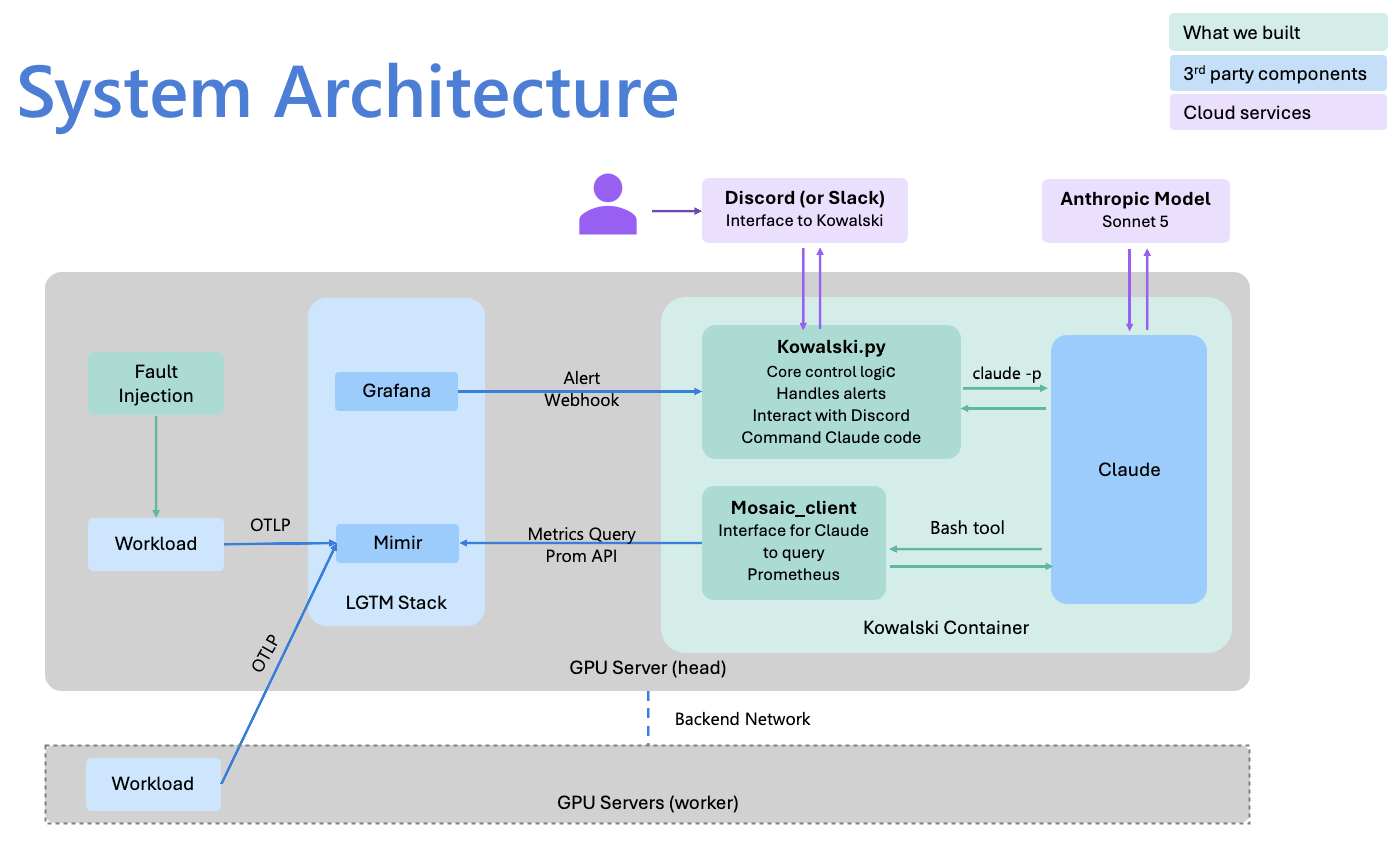
An agent skill that diagnoses cluster faults from profiler metrics. Kowalski1 is the bot that runs it.
A Grafana alert fires, Kowalski invokes Claude Code headlessly against the skill, the agent investigates through a fixed set of read-only scripts, and the diagnosis lands in chat. Nobody is in the loop.
Installing it is covered in Fault Detective Deployment.
How it works#
The loop#
| Stage | Component |
|---|---|
| Alert evaluates and fires | Grafana alert rule |
| Alert delivered as a webhook | Grafana contact point |
| Mode and cooldown checked | kowalski.py HTTP receiver |
| Agent invoked headlessly | claude -p subprocess |
| Skill loaded, investigation planned | Claude Code with the mosaic-detective skill |
| Metrics queried | Scripts in scripts/, via mosaic_queries.py |
| Diagnosis posted | kowalski.py chat client |
Everything from the receiver down runs in one container on the head node. An injected fault reaches a posted diagnosis in about two minutes.
Grafana alert rules#
Alert rules decide that something is wrong, not what is wrong. Nothing from the alert reaches the agent beyond the rule title, which is used for the chat message.
Grafana Alerting has the expressions and how to calibrate them.
kowalski.py#
One process running the chat bot and the HTTP receiver, sharing an in-memory mode flag:
ARMED diagnoses and posts, NOTIFY announces the alert and waits to be asked, DISARMED
posts nothing. It starts ARMED and returns there on every restart.
Kowalski, analysis runs a diagnosis in any mode, DISARMED included. Disarming stops
autonomous diagnosis, not the bot.
A global three minute cooldown follows any alert, and a non-blocking lock means a manual summon
during a run is told it is already covered rather than starting a second agent. Diagnosis runs
on a daemon thread so the handler can return immediately, or Grafana times out and retries. Resolved alerts are dropped, and
a non-zero exit from claude -p is caught and posted rather than read as a successful run with
nothing to say.
The skill#
A Claude Code Agent Skill loaded as a unit: SKILL.md with the trigger and the diagnostic
procedure, alongside fault-signatures.md and metrics-reference.md. Those files are not
documentation about what the agent does. They are what it does. See The reference documents
are the program.
The skill runs from its installed location, not the repository. sync-skill.sh copies it into
place, and an unsynced edit has not taken effect.
Wrapper scripts#
The agent does not write queries. It picks among four read-only scripts in scripts/:
| Script | Question it answers |
|---|---|
check_collector_health.py |
Is the observability pipeline itself up? |
list_metrics.py |
What metrics exist, and which are trusted? |
metric_timeline.py |
How has one metric moved over a window? |
compare_ranks.py |
Do the ranks or links differ from each other? |
metric_timeline.py scans for rate-of-change transitions, catching both a frozen counter and a
gauge stepping down. compare_ranks.py groups by rank or link, comparing means for gauges and
deltas for counters.
mosaic_queries.py#
Connections, query construction, typed results, and the metric names the wrappers use held as constants. No diagnostic logic lives here, so a bad diagnosis traces to a bad query or a bad inference, never both at once.
Design decisions#
Guided, not caged#
The agent picks the investigative move. It does not pick the metric, which is fixed inside each wrapper in tested code. A doctor ordering a blood panel does not get to redefine what the blood panel measures.
The boundary is deliberately left open. On one kill-rank run the agent went outside the wrappers to query process counts, checking whether the processes had actually exited. It was right, and the diagnosis was better for it. Wrappers-only is blind to anything you did not anticipate; open query access is more capable and can fabricate. The current position takes the safe side.
Detection deterministic, diagnosis agentic#
Alert rules are cheap, fast and predictable, and run continuously. Agent invocations are none of those. The deterministic gate means the expensive part only runs once something simple has established there is a reason to look.
Why not a decision tree#
The Fault Playbook is that tree, and for the faults written into it a deterministic implementation is faster and cheaper. Run that first.
Every branch of a tree is a fault someone already knew about. The agent picks its next query from what the last one returned, so it can investigate one nobody encoded — on the kill-rank run above it went outside the wrappers to count processes, a step no branch contains. A tree falls off the end and returns nothing; the agent returns what it ruled out and what evidence would settle the rest.
Maintenance splits the same way. A new metric means rewriting branches. A new signature is a paragraph.
Fault injection stays outside#
The injection harness is not packaged with the detective, and the detective has no write path to the cluster. Every script it can run is a query.
Limitations#
- Discord is the only chat platform currently supported. Slack is planned; see Extending to another chat platform.
- Some faults cannot be localized, and the skill says so rather than guessing. A network fault cannot be pinned to a node on a bulk-synchronous ring, and a killed rank cannot be identified at typical scrape resolution because the abort propagates within one scrape interval. The Fault Playbook covers why.
- Combination faults are untested.
- Signatures are calibrated to one cluster: two nodes, four GPUs, 1 GbE, network bound. A GPU clock clamp is the clearest case , the clocks move and the alert rule sees it, but throughput does not, because the network is the constraint. On a compute bound cluster that reverses. The method transfers; the numbers do not.
Extending to another chat platform#
Slack is planned. The coupling is small and sits at both ends: the diagnosis is text and one function posts it, and the interactive commands are a thin surface over the same mode flag. A second platform is another implementation of each, selected by which credentials are configured.
Formatting is the work, since platforms differ in Markdown dialect and message length caps. Transport is not: posting needs no inbound connectivity, and an outbound WebSocket mode can be driven from behind a firewall.
Future improvements#
- Historical and offset queries are the obvious next tooling gap.
- An MCP server instead of wrapper scripts, giving the agent a typed tool surface rather than a shell command per verb.
- Very basic write access, so the agent can act on a diagnosis rather than only report it, restarting a rank or a node being the obvious first case.
- Widening the line between wrapper only access and open queries, so the agent can ask questions the wrappers do not anticipate.
- Separating a throttle induced abort from a deliberate rank kill. It needs the pre-abort trajectory, which snapshot based tooling discards.
- Handling a fault type the agent has never seen.
-
Named after the legendary analyst penguin from the Madagascar films, whose catchphrase is "Kowalski, analysis!" That is also the phrase that triggers the skill. ↩